
Non categorizzato
Motorcycle ABS Problems: ABS Light After Tire Change Diagnosis
May
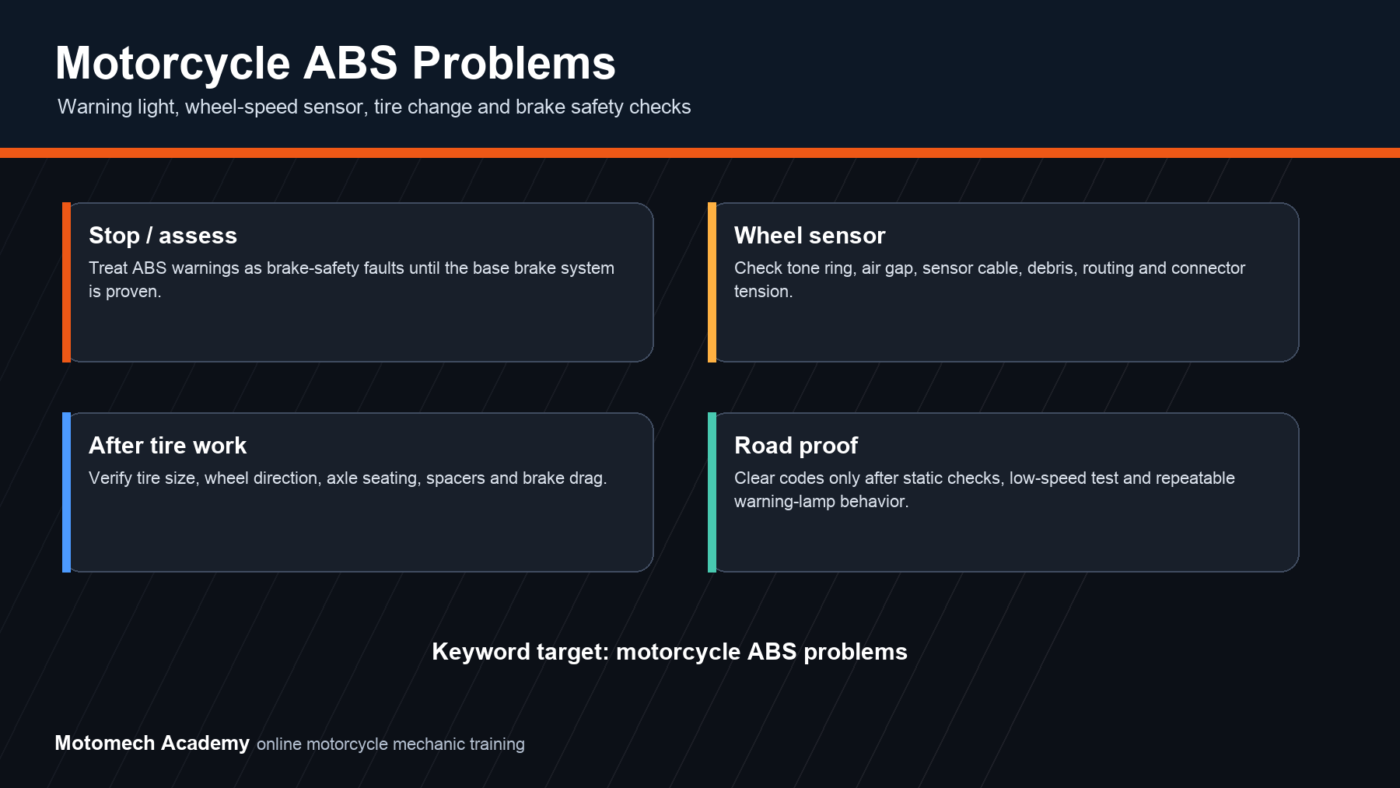
Motorcycle ABS problems should be treated as brake-safety faults until the basic brake system, wheel-speed sensing and recent wheel work have been checked. The Search Console source query for this guide is a forum case where an ABS light appeared after changing the front tire, a pattern that often points to sensor gap, tone ring, cable routing, axle seating, tire-size mismatch or connector disturbance.
This guide gives riders and students a structured diagnostic path before replacing expensive ABS parts. It supports the Motomech brake systems and troubleshooting training path, and it links back to the real source case: ABS light after changing the front tire.
Stop first: ABS warning is a safety signal
If the ABS light stays on, comes back after riding, or appears after brake or wheel work, do not assume the system is safe. The normal hydraulic brakes may still work, but anti-lock control may be disabled or unreliable. Before a road test, confirm that the lever or pedal feels normal, there is no fluid leak, the wheel rotates freely and the brake caliper is mounted correctly.
For a regulatory definition, U.S. motorcycle brake rules describe ABS as a system that senses wheel slip and modulates brake pressure to limit wheel slip. The practical lesson is simple: if wheel speed sensing is wrong, ABS logic can be wrong. See the official brake-system definition in 49 CFR 571.122 Motorcycle Brake Systems.
Common causes of motorcycle ABS problems
- Wheel-speed sensor gap: sensor too far from the tone ring after wheel installation, fork work or spacer error.
- Dirty or damaged tone ring: bent ring, missing teeth, rust, metal debris, brake dust or impact damage.
- Sensor cable routing: stretched cable, trapped wire, rubbed insulation or connector pulled during tire replacement.
- Tire size or profile change: front/rear rolling diameter mismatch can confuse ABS or traction logic on some motorcycles.
- Battery and voltage faults: weak battery or charging issue causing ABS module undervoltage during startup.
- Brake drag or bearing issue: wheel does not spin freely, causing inconsistent wheel-speed readings.
- Stored fault after repair: warning stays until a short ride cycle or diagnostic reset, depending on model.
ABS light after changing a front tire
When the ABS light appears right after a tire change, start with what was disturbed. Do not replace the ABS module first. Work through the front wheel and sensor area in this order:
- Confirm the front wheel is installed in the correct direction and the tire size matches the motorcycle specification.
- Check that axle spacers are on the correct sides and the axle is seated/torqued correctly.
- Inspect the ABS tone ring for bends, scratches, missing teeth or debris.
- Measure or visually confirm the wheel-speed sensor gap if the service data gives a value.
- Follow the sensor wire from pickup to connector; look for stretched, trapped or twisted routing.
- Spin the wheel by hand and listen for brake drag, bearing noise or rotor contact.
- Check battery voltage and charging output if the warning appears at startup or after a cold start.
Diagnostic workflow before replacing parts
Use a proof-first sequence. The ABS module is often blamed too early, but many faults are installation, wiring, voltage or wheel-speed signal problems.
- Baseline brake check: lever feel, pedal feel, fluid level, leaks, pad/rotor condition and caliper mounting.
- Visual wheel check: tire size, tire direction, spacers, axle, rotor and tone ring.
- Sensor check: air gap, cable routing, connector pins, water intrusion and continuity where service data allows it.
- Voltage check: battery resting voltage, cranking drop and charging output.
- Code scan: read ABS module codes if your tool supports the motorcycle brand.
- Low-speed verification: only after static checks, confirm whether the ABS light clears or returns.
When not to ride
Do not ride if the brake lever feels soft, the pedal sinks, the caliper is loose, a brake line leaks, the wheel does not rotate freely, the tire direction/size is uncertain, or the ABS warning appears with other electrical faults. Fix the base brake condition first.
Motomech learning path
- Motorcycle Brake Systems Course
- Motorcycle Brakes Still Spongy After Bleeding
- Motorcycle Troubleshooting Guides
- Motorcycle Diagnostics Course
- Online Motorcycle Repair Help
Motorcycle tyre scalloping
For cupped front tire wear, vibration and chassis checks, use the Motorcycle Tyre Scalloping diagnostic guide.


