
Non categorizzato
Motorcycle Tyre Scalloping: Front Tire Cupping Diagnosis
May
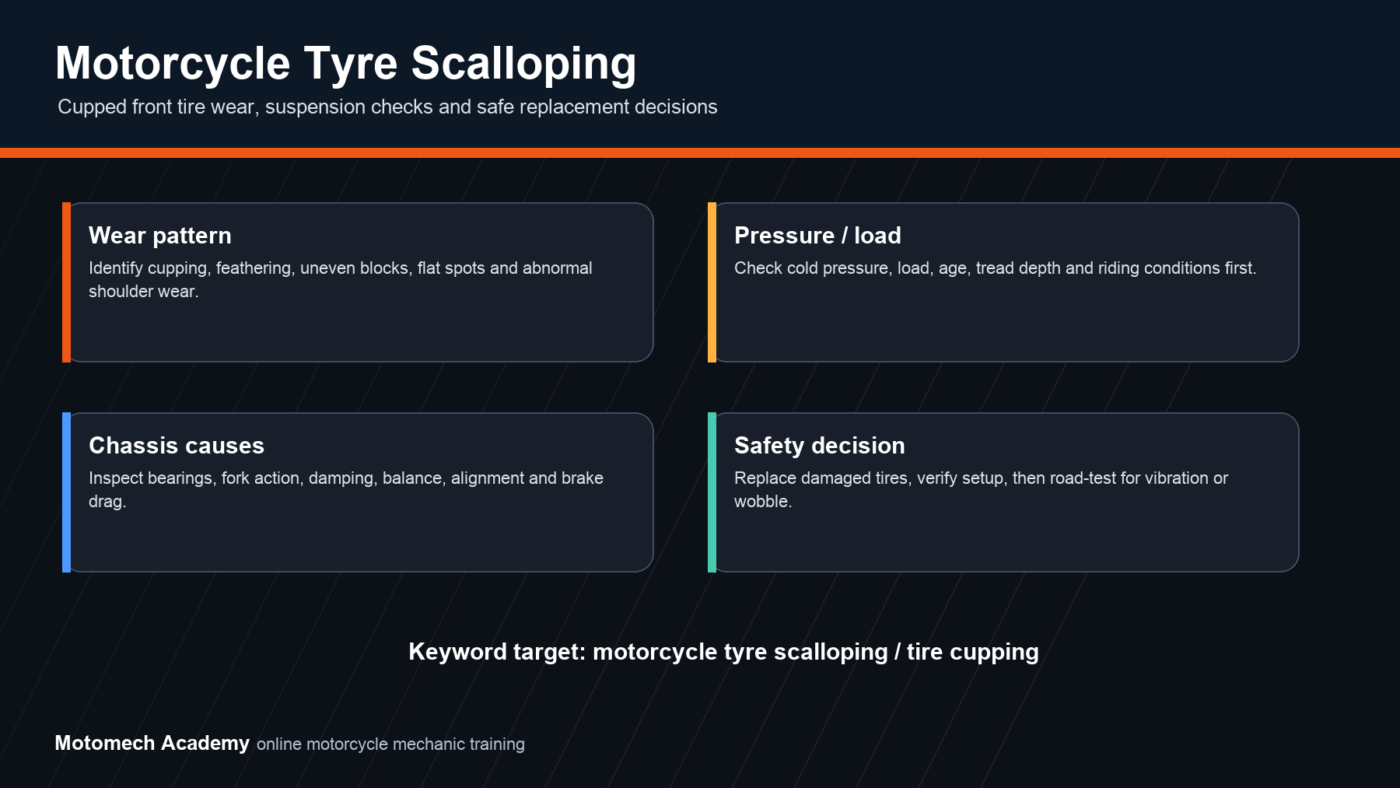
Motorcycle tyre scalloping, also called tire cupping, is an uneven wear pattern where parts of the tread look scooped, feathered or wavy instead of smooth. Search Console showed Google testing the forum topic front tire has a weird scalloped wear pattern, so this guide turns that case into a structured diagnostic workflow.
Scalloping is not only a cosmetic tire issue. It can affect vibration, steering feel, braking confidence and wet-weather grip. If the tire is damaged, deeply uneven, cracked, old, under-inflated or close to the wear bars, treat replacement as a safety decision before tuning suspension or chasing small geometry changes.
What scalloped motorcycle tyre wear looks like
- Alternating high and low tread blocks around the tire.
- Feathered edges that feel rough in one direction when you run a hand over the tread.
- Wavy shoulder wear, often more visible on the front tire.
- Handlebar vibration, humming noise or a pulsing feel as speed changes.
- A tire that tracks grooves or feels vague while leaning.
Start with tire safety basics
Before diagnosing suspension, confirm tire condition. NHTSA tire safety guidance warns riders and drivers to pay attention to tread, pressure, physical damage and irregular wear. Use that same logic here: scalloping is a reason to inspect the whole tire, not just the visible high spots. See NHTSA’s official tire safety resource: NHTSA TireWise.
Common causes of motorcycle tyre scalloping
- Incorrect tire pressure: under-inflation and repeated heat cycles can accelerate uneven wear.
- Worn or weak damping: a fork or shock that cannot control oscillation may let the tire skip and wear unevenly.
- Wheel imbalance: vibration at speed can create repeated tread loading.
- Wheel bearing or steering-head play: looseness can create instability that marks the tire.
- Brake drag: a dragging caliper can add heat and load to the front tire.
- Aggressive road texture or riding style: hard braking, rough roads and long mileage can contribute.
- Old tire compound: age and hardening can make wear patterns worse even when tread depth looks acceptable.
Diagnostic workflow
- Check cold tire pressure against the motorcycle/load recommendation.
- Inspect tread depth, age code, cracks, cuts, bulges, puncture repairs and exposed cords.
- Spin the wheel and listen for bearing noise or brake drag.
- Check wheel balance if vibration appears at a repeatable speed.
- Inspect fork seals, fork movement, rear shock damping and suspension sag.
- Check steering-head bearing play and front wheel bearing play.
- Review recent changes: new tire, different size, tire direction, wheel installation, brake work or suspension adjustment.
- If the tire is kept in service temporarily, monitor whether vibration, wobble or grip confidence changes. Replace if in doubt.
When to replace instead of diagnose longer
Replace the tire if the scalloping is severe, the tread is near the wear indicators, the tire is cracked, has a bulge, shows cord, has an unsafe puncture repair, or the motorcycle shakes/wobbles in a way that cannot be isolated immediately. A new tire does not fix a worn fork or loose bearing, but a damaged tire is not a good diagnostic baseline.
Motomech related path
- Motorcycle ABS problems diagnosis
- Motorcycle brake systems course
- Motorcycle troubleshooting guides
- Motorcycle diagnostics course
- Motorcycle mechanic certification online


