
Motorcycle Mechanic Guides
PZ26 and PZ27 Carburetor Adjustment: Baseline Tuning Guide
May
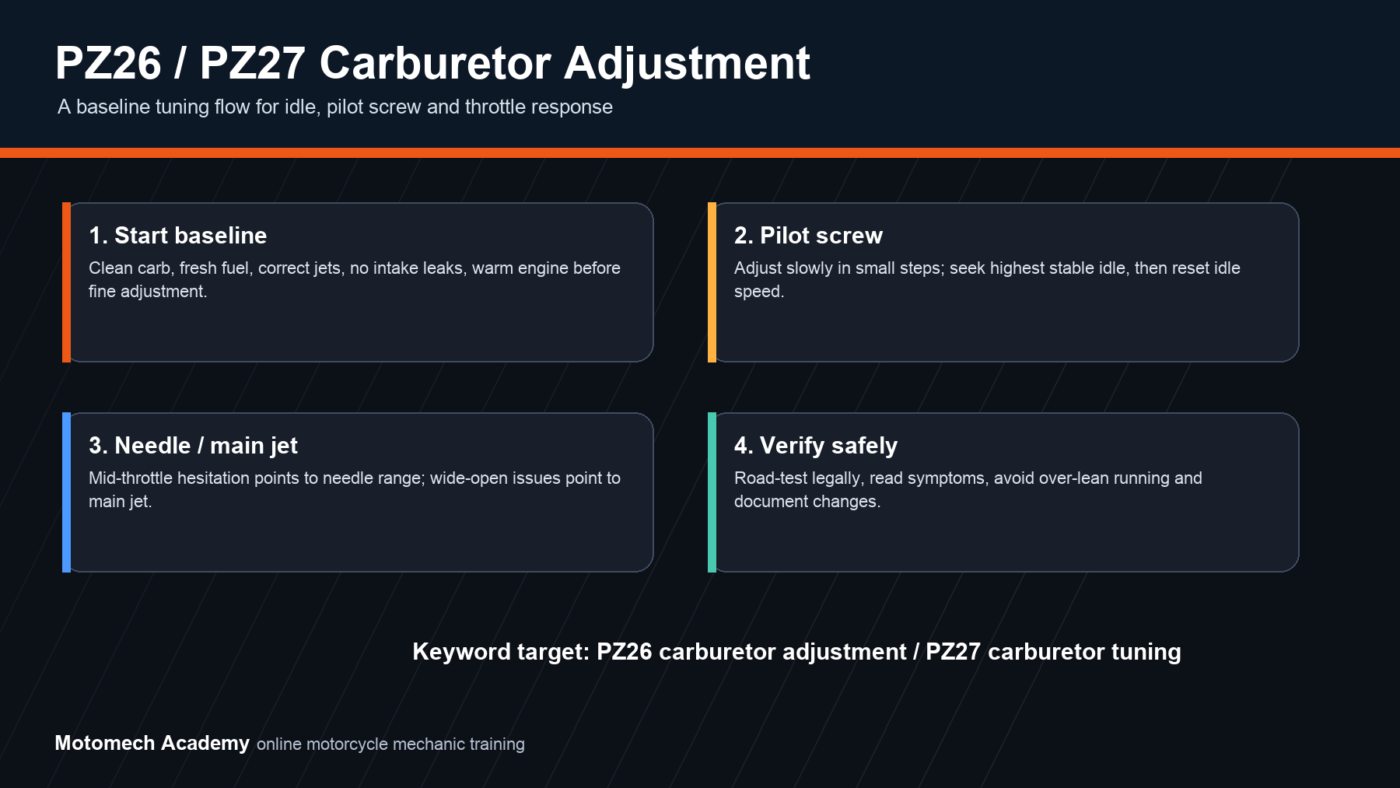
PZ26 and PZ27 carburetors are common on small motorcycles, pit bikes, scooters, ATVs and engine swaps. They are simple enough to learn on, but they can become frustrating when idle, pilot screw, needle and main jet changes are made without a baseline. This guide gives a safe diagnostic sequence for PZ26 carburetor adjustment, PZ26 carburetor tuning and PZ27 carburetor tuning.
The goal is not to chase random jet numbers. The goal is to make one controlled change at a time, read the symptom correctly and avoid dangerous lean running.
Before adjusting: confirm the engine is tuneable
A carburetor cannot compensate for a weak engine, air leak or bad ignition. Before touching the pilot screw, confirm basic service condition: clean fuel, clean tank, clean carburetor passages, correct float height, good spark plug, clean air filter, no cracked intake boot and no exhaust leak near the head. Warm the engine fully before final idle adjustment.
PZ26 and PZ27 baseline checklist
- Carburetor cleaned and jets verified, not just sprayed from outside.
- Throttle cable has free play and the slide returns cleanly.
- Air filter is installed; do not tune final mixture with the filter removed.
- Intake manifold and vacuum ports have no leaks.
- Fuel flow from tank and petcock is stable.
- Spark plug is correct type and not fouled from previous testing.
Idle speed vs pilot screw
The idle speed screw sets slide opening. The pilot screw fine-tunes the idle and low-throttle mixture. If the engine only runs with the idle screw turned far in, the pilot circuit may be blocked, the pilot jet may be wrong, the float height may be off, or there may be an air leak. Make small adjustments and wait for the engine to respond.
How to adjust the pilot circuit
- Warm the engine fully.
- Set idle slightly higher than normal so it does not stall during adjustment.
- Turn the pilot screw in small steps and listen for the highest, smoothest idle.
- Reset idle speed after the best pilot position is found.
- If the best setting is extremely far in or out, inspect the pilot jet size and air leaks.
Reading throttle-range symptoms
Carburetor diagnosis is easier when you map the symptom to throttle range. Idle and just-off-idle are mostly pilot circuit. Mid-throttle is usually needle position and needle jet behavior. Wide-open throttle points more toward the main jet and fuel delivery. A hesitation when snapping the throttle can also be caused by lean pilot settings, slide response or accelerator-pump absence depending on the carburetor design.
Rich vs lean clues
- Lean clues: hanging idle, intake popping, needs choke when warm, heat, flat response, pale plug under correct test conditions.
- Rich clues: black plug, fuel smell, burbling, poor hot restart, heavy throttle response and smoke on some engines.
Safe road testing
Road-test legally and safely. Do not do high-speed tests on public roads. Make one change, document it, then compare the same throttle range again. If the engine gets hotter, pings, loses power or feels unstable, stop and return to a safer baseline.
Related Motomech training
Carburetor work becomes easier when it is connected to full diagnostic thinking. Start with the Motorcycle Diagnostics Course hub, then build fundamentals with the Online Motorcycle Mechanic Course hub. If ignition symptoms overlap with carburetor symptoms, read Motorcycle Ignition Coil Symptoms and Troubleshooting.
Forum case to compare
This article supports the live forum thread already receiving impressions: PZ27 carburetor tuning forum case.
More motorcycle tuning guides
This guide is part of Motomech Academy’s Motorcycle Tuning Guides hub, where model-specific upgrade checklists are connected with diagnostics, electrical testing, service baselines and forum case studies.


