
Motorcycle Mechanic Guides
Honda Forza 350 Tuning: Safe Upgrade and CVT Checklist
May
Honda Forza 350 tuning searches usually come from riders who want stronger acceleration or a sharper scooter feel. The safest path is to check service condition, CVT behavior and drivability before changing intake, exhaust or fueling.
This guide is built from a Search Console query where Google is already testing the Motomech forum. The goal is to give that intent a stronger central article.
Service before parts
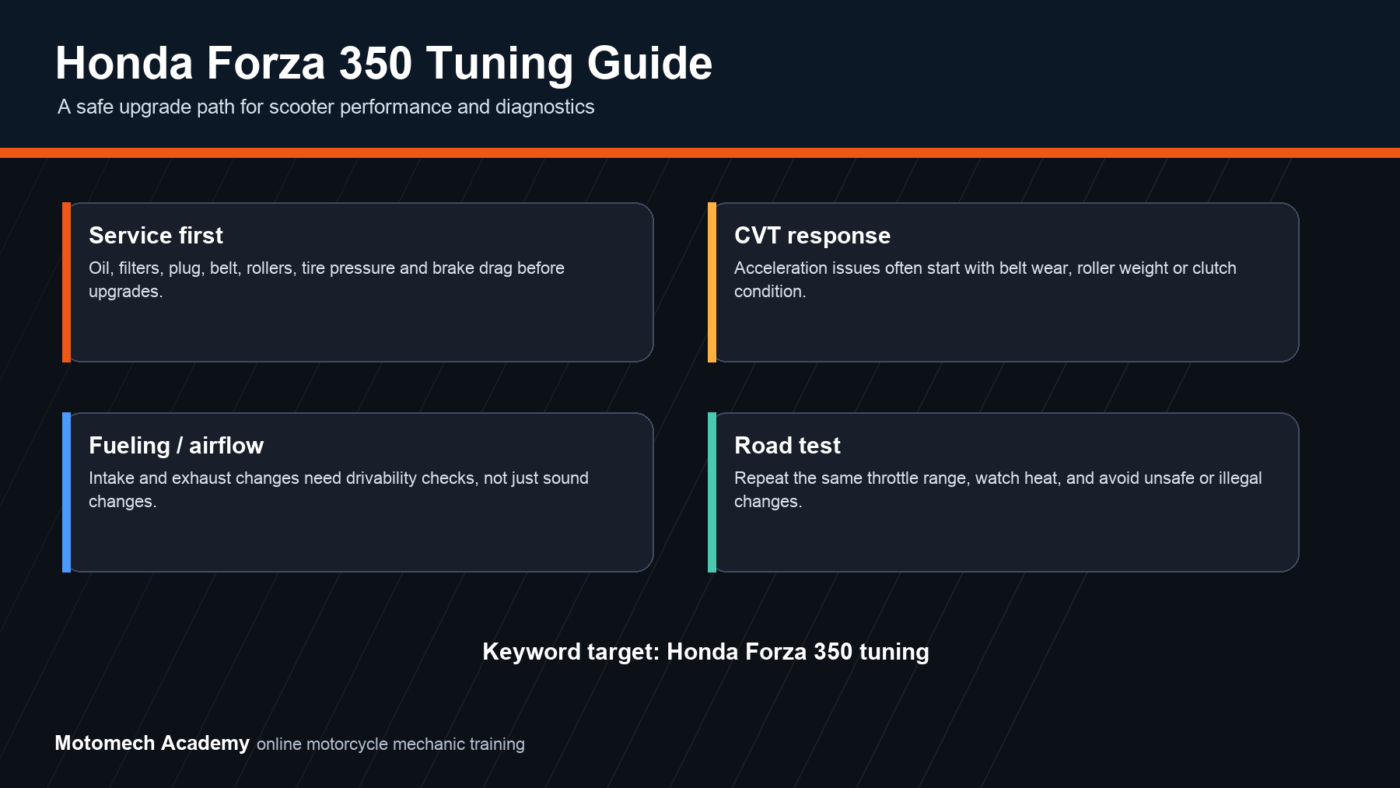
Start with oil, filters, spark plug, tire pressure, brake drag, belt condition, roller wear and clutch behavior. A Forza 350 with a worn belt or dragging brake can feel like it needs tuning when it really needs service.
CVT and acceleration symptoms
Most scooter acceleration complaints need CVT context. Note take-off rpm, vibration, flat spots, heat behavior and whether the symptom appears loaded, uphill or after warm-up. A tuning part should not be used to hide a worn transmission part.
Intake, exhaust and fueling
Airflow changes can affect mixture and drivability. If a modification creates popping, surging, heat, poor idle or flat throttle response, return to diagnosis. Sound is not proof of performance.
Road-test logic
- Test the stock scooter and write down symptoms.
- Service known wear items first.
- Make one change.
- Repeat the same route and throttle range.
- Stop if heat, noise or hesitation increases.
Related Motomech training
For fault isolation, use the Motorcycle Diagnostics Course hub. For service foundation, use the Online Motorcycle Mechanic Course hub. For charging and sensor-related symptoms, continue with the Motorcycle Electrical Course hub.
Forum case to compare
This guide supports the live forum topic: Honda Forza 350 tuning forum case.
More motorcycle tuning guides
This guide is part of Motomech Academy’s Motorcycle Tuning Guides hub, where model-specific upgrade checklists are connected with diagnostics, electrical testing, service baselines and forum case studies.


