
online motorcycle mechanic training: what should a beginner practice first?
I am looking for online motorcycle mechanic training that actually helps a beginner work safely on a real motorcycle. I do not need a course that only says "this is a piston" and then disappears. I want to know what to practice first, which tools matter, how to diagnose instead of guessing, and when a job is too risky for a beginner.
The free course here looks like a good starting point: online motorcycle mechanic training. I wanted to ask the forum how you would use it in a practical order. Should I begin with service checks, electrical basics, brakes, no-start diagnosis, or reading manuals?


Discussion
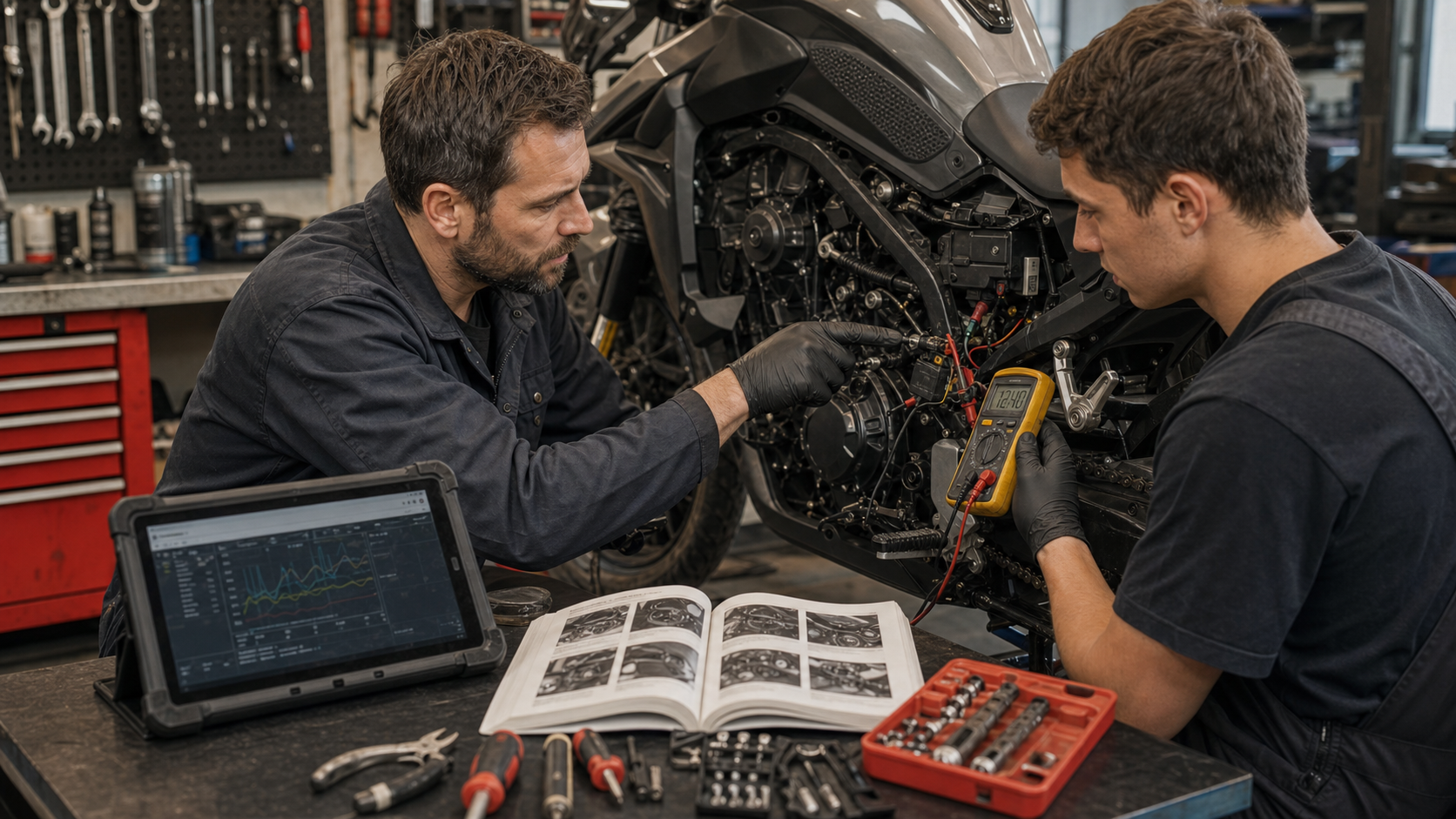
32 repliesFor online motorcycle mechanic training, I would start with the multimeter earlier than most people think. Battery rest voltage and cranking voltage explain so many "mystery" problems. Once I learned that, I stopped blaming the starter relay for everything.
Photos before disassembly saved me. I used to trust my memory, which was optimistic and wrong. Now every online motorcycle mechanic training lesson becomes a small checklist with pictures.
Brake work still scares me, in a healthy way. I can inspect pads and fluid, but bleeding brakes took me time. I like courses that say what not to touch yet.
A useful order for learning
Thomas Spagnoli here. Good online motorcycle mechanic training should build habits before confidence. Confidence without method is how beginners strip threads, clear fault codes before recording them, adjust three screws at once, and then wonder why the bike now has a personality disorder.
Start with inspection and safety. Learn tire age, pressure, tread, brake pad wear, brake fluid condition, chain slack, sprocket wear, loose fasteners, leaks, damaged wiring, battery terminals, lights and controls. This is not glamorous, but it prevents dangerous mistakes. A beginner who can inspect well is already useful.
Then learn maintenance as diagnosis
Oil, filters, spark plugs, coolant, chain service, brake service, clutch free play, throttle free play and valve clearance are not just maintenance tasks. They are diagnostic baselines. If the baseline is wrong, every symptom becomes confusing. Online motorcycle mechanic training should teach you to make the bike honest before judging it.
Electrical basics come early
Learn battery voltage at rest, cranking voltage, charging voltage, voltage drop, fuse testing under load, relay logic, ground checks and connector inspection. Many beginners fear electrical work because they only see diagrams. Start with measurements on a healthy bike. A healthy bike is the best teacher because it shows what normal looks like.
Practice path
The best way to use online motorcycle mechanic training is to pair every lesson with one safe real-world check. Watch less, measure more, and keep notes. That is how knowledge becomes workshop judgment.
A no-start checklist should be mandatory. Air, fuel, spark, compression, battery voltage, side stand switch, kill switch, fuses. Online motorcycle mechanic training should make that order automatic.
I learned more from servicing a boring commuter than from watching performance videos. Oil, chain, plugs, filters, brake pads. Boring bike, excellent teacher.
Chain adjustment is a perfect beginner job if someone teaches it properly. Too tight is bad, too loose is bad, dirty is bad. The chain has many opinions.
Chain service is a good early lesson because it combines inspection, measurement, adjustment, lubrication, rear wheel alignment and safety. It also teaches that "tight" is not the same as correct.
For me, online motorcycle mechanic training helped because I could pause and repeat. In a real shop I felt rushed. At home I could watch one step, do one step, and check the manual.
Tool buying advice matters. Beginners buy huge kits and still miss the correct torque wrench or feeler gauges. Ask me how I know, actually do not.
Road testing should be taught too. After a repair, short slow test first, then recheck leaks, fasteners, brake feel, chain and temperature. Do not just blast down the road in celebration.
Correct. Verification is part of repair. A job is not finished when the part is fitted; it is finished when the bike is inspected, tested safely, and rechecked.
Clutch cable adjustment made me feel like a genius for ten minutes. Then I realized the manual had been telling me the answer all along. Manuals are rude like that.
I think online motorcycle mechanic training should include "previous owner archaeology." Every used bike has at least one strange decision hidden under tape.
Valve clearance is the first job I would not do alone. I want to understand it first, then maybe practice with someone experienced.
That is wise. Learn the theory, watch the process, understand timing marks and specifications, then decide if you have the tools and calm environment. Some jobs are excellent supervised practice, not first solo attempts.
I like writing down symptoms before touching anything. It stops me from changing my story after the first test.
Oil changes are simple but still teach discipline: correct oil, washer, torque, filter orientation, leak check, disposal. Simple does not mean careless.
The free course link is useful because it gives structure. Forums are great, but without a path I end up reading about carb jets at midnight when my problem is a weak battery.
That is why a course and a forum work well together. The course gives the order. The forum gives real cases. Use both, but do not let random threads replace a diagnostic sequence.
Torque specs changed my life. My old method was "tight enough plus anxiety." Not ideal.
For online motorcycle mechanic training, I want more real examples where the first guess is wrong. That is how repair actually feels.
A healthy-bike baseline is underrated. Measuring charging voltage on a bike that works taught me what to expect when one does not.
Exactly. Measure normal before hunting abnormal. A beginner with normal readings in their notebook learns faster when a fault appears.
Wiring connectors are where I learned patience. Green pins, loose grounds, bad crimps. Tiny things, huge mood swings.
Tires and brakes should be early lessons. They are not exciting online, but they decide whether you get home with all the drama you planned and none you did not.
Fuel problems taught me to stop assuming. Old fuel, clogged filter, dirty injector, vacuum leak. Same complaint, different cause.
That is diagnosis: same symptom, multiple possible causes, tested in order. Online motorcycle mechanic training should teach decision-making, not memorized part replacement.
Coolant service on small bikes is a good beginner-intermediate job. It teaches bleeding, hoses, clamps, fan checks and patience.
I joined the training and started with inspection. It made me realize my bike had three small issues I had been ignoring because they were not loud yet.
Best beginner sentence: one change at a time. I used to change five things and then call myself efficient. I was just hiding the answer from myself.
Perfect closing lesson. One change, one test, one note. That rhythm turns online motorcycle mechanic training into real mechanical skill.