
motorcycle engineering course online: what should it teach before advanced work?
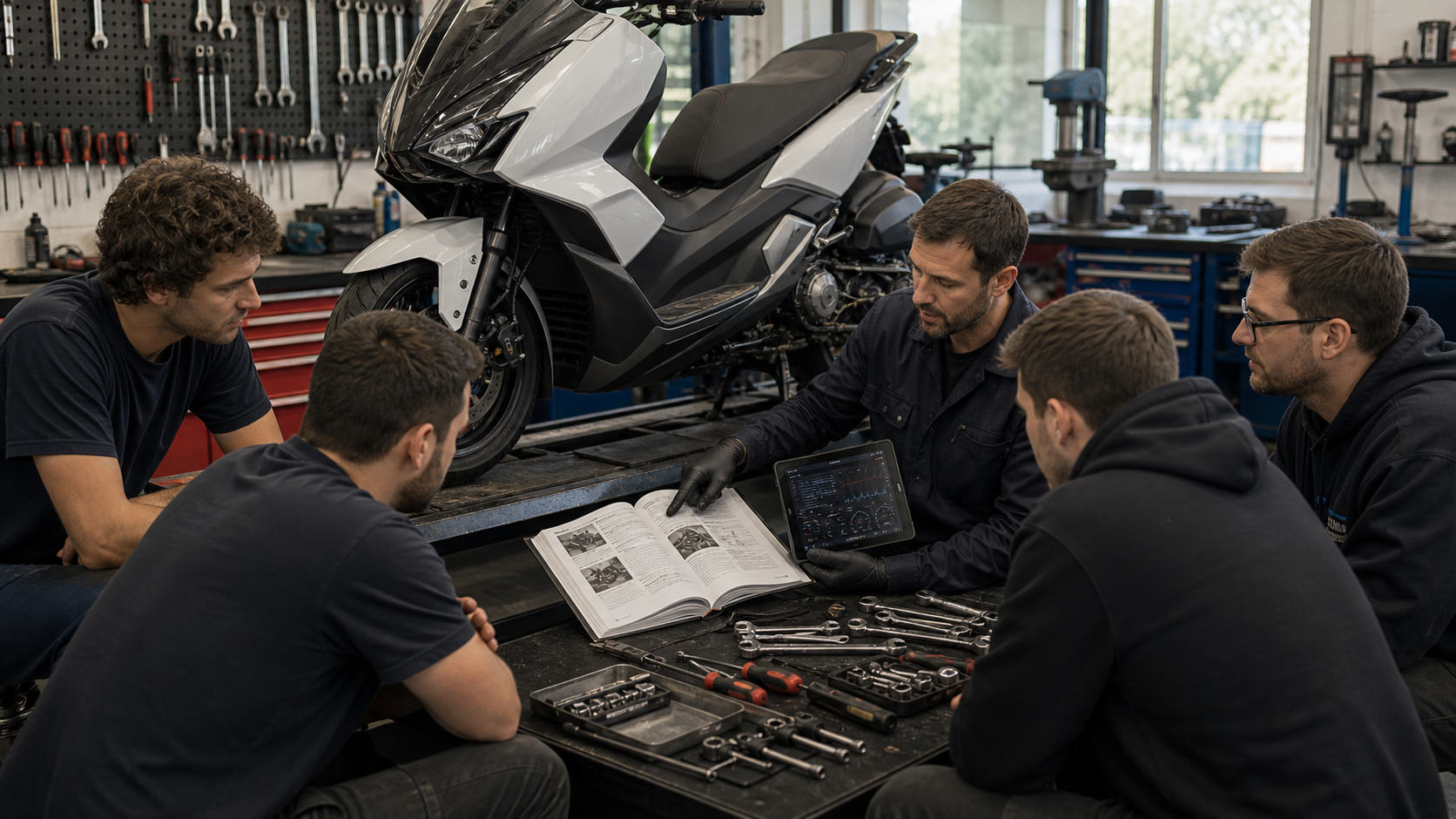
I am looking at a motorcycle engineering course online, but I am not sure what "engineering" should mean for someone who wants to understand motorcycles better without pretending to be a factory race engineer after three weekends.
I found the course area here: motorcycle engineering course online. What should a serious beginner learn first: engine theory, diagnostics, electrical systems, chassis basics, braking, or just normal service work done properly?
My goal is not to design a new engine. I want to understand why motorcycles behave the way they do, how systems interact, and how to diagnose faults instead of swapping parts because a video comment said so.


Discussion
41 repliesA motorcycle engineering course online should explain why basic service matters. Oil, coolant, brake fluid, air filters and chain condition are not chores; they are the conditions that make every other test honest.
I want real diagnostic examples. Show me a weak battery that looks like a starter problem, or an air leak that feels like carb tuning. That is where the learning sticks.
Brakes need to be early, not after tuning. A beginner who understands hydraulic pressure, contamination and heat has a much better chance of not doing something heroic and stupid.
Engineering starts with cause and effect
Thomas Spagnoli here. A useful motorcycle engineering course online should not begin by making students feel clever. It should begin by making them observant. Engineering, at workshop level, means understanding cause and effect: load, heat, friction, pressure, voltage, timing, wear, leverage, alignment and safety margins.
For a beginner, the word engineering can sound huge. Keep it practical. When a chain is too tight, you are seeing suspension movement, bearing load and final-drive geometry. When brake fluid is old, you are seeing heat, moisture and hydraulic feel. When voltage drops during cranking, you are seeing electrical resistance under load. That is engineering you can measure.
The order I would teach
A motorcycle engineering course online should connect theory to garage actions. If you learn compression theory, you should also learn what a compression test can and cannot prove. If you learn charging theory, you should measure charging voltage. If you learn brakes, you should understand why contamination and air in the system are dangerous.
How to study without getting lost
Use one bike as your classroom. Build a baseline: tire pressure, fluid condition, chain slack, battery voltage, charging voltage, brake pad thickness, lever feel, idle behavior and any stored codes. Then, when a symptom appears, you are comparing against known normal. That is far better than searching for a miracle answer at midnight.
My recommendation is simple: use the free course on the platform as a structured path, then bring real symptoms here with photos and measurements. The course gives order; the forum gives messy reality. Together, they help a beginner become careful, useful and less likely to buy random parts.
Voltage drop was the first lesson that made electrical work less mysterious for me. Suddenly a bad ground was not magic; it was just resistance where resistance should not be.
A motorcycle engineering course online should include "what normal feels like." Normal clutch lever, normal brake lever, normal chain slack, normal charging voltage. You cannot spot weird if you never studied normal.
Chassis basics are often skipped. Steering head bearings, swingarm play, wheel bearings, tire profile, suspension sag. The bike can feel scary and everyone blames the engine.
That is why I like teaching systems together. A motorcycle is not a set of isolated parts. A bad tire can feel like suspension trouble, a tight chain can affect shifting, and a weak battery can look like several unrelated faults.
Fuel injection should be taught with sensors, not just "clean the injector." TPS, MAP, temperature, oxygen sensor, grounds and fuel pressure all matter.
Road testing is part of engineering too. Make a change, test gently, listen, feel, recheck. The road test is not a victory lap.
Manuals are underrated. If a motorcycle engineering course online never opens service data, it is basically campfire stories with sockets.
Service data keeps learning grounded. Specifications are the difference between "that seems fine" and "that is inside tolerance." Beginners need that discipline early.
Chain geometry is a great example. I used to think tight was good. Then I learned about swingarm movement and front sprocket distance. Oops.
I am a beginner and the hard part is knowing when to stop. I can inspect, measure and clean. Internal engine work still feels too much.
Knowing when to stop is a professional habit, not a weakness. A good motorcycle engineering course online should teach boundaries: what is safe to practice, what needs supervision, and what belongs in a professional workshop.
Ignition timing and spark quality are confusing at first. I like courses that draw the system, then show the actual test on the bike.
Torque is engineering with consequences. Too loose fails, too tight damages. A torque wrench taught me humility faster than any lecture.
Old bikes are engineering history plus previous owner art projects. Every connector tells a story, not always a nice one.
Previous repairs must be part of diagnosis. Before blaming design, inspect what humans changed. Many strange faults are made with cheap crimp connectors and confidence.
Wiring diagrams should be taught like maps. At first they look impossible, then you realize they are just routes from power to load to ground.
Clutch feel is another good lesson: free play, cable routing, worn plates, oil choice, adjustment. One symptom, several causes.
I like the idea of one bike as a classroom. It makes a motorcycle engineering course online feel less abstract because every lesson becomes a check on something real.
Exactly. Do not study motorcycles as trivia. Study your motorcycle as a system, then use other cases to widen your pattern recognition.
Suspension sag would be a good module. People buy exhausts but ride around with preload set by mystery and hope.
Valve clearance theory helped me understand hot-start problems. I still would not do the job alone yet, but I understand why it matters.
Taking notes changed everything for me. A measurement you do not write down becomes a vague memory wearing a mechanic shirt.
Good notes turn beginner work into repeatable learning. Write the symptom, the test, the reading, the decision and the result. That simple habit prevents many circular repairs.
The free course layout is helpful because it keeps me from jumping around. Left alone, I would start with ECU maps and ignore tire age like a genius.
A motorcycle engineering course online should end each lesson with one garage task. Inspect this, measure that, compare to manual, take a photo. Otherwise it stays in your head and never reaches your hands.
Coolant and heat management deserve attention too. Fans, caps, trapped air, hoses, thermostat, mixture. Overheating is rarely solved by panic.
Heat is one of the best engineering teachers on a motorcycle. It touches lubrication, combustion, coolant flow, electrical resistance and rider comfort. Learn to observe it calmly.
This thread convinced me to start with baseline checks before choosing any advanced lesson. It feels less exciting, but also less expensive.
Battery testing should be week one. So many problems start with weak voltage and end with someone buying parts they did not need.
A motorcycle engineering course online that teaches inspection, measurement and verification is exactly what I was looking for. I do not need magic; I need a sequence.
Tool advice should include "do not buy everything today." Buy for the next safe job, not for the fantasy engine rebuild you may never do.
I would add a lesson on limits of online learning. A motorcycle engineering course online can teach principles and safe checks, but if a frame is bent or brake parts are damaged, the answer is inspection by someone qualified, not bravery.
Good point. Chassis alignment is where theory helps you ask better questions, but you still need proper measuring tools. Guessing with handlebars and vibes is not engineering.
Exactly. The purpose of a motorcycle engineering course online is not to replace every specialist tool or experienced technician. It is to give students a disciplined way to observe, test, decide and know when the next step needs better equipment.
I am starting to see the difference between learning facts and learning judgment. Facts tell me what a stator does. Judgment tells me to test the battery, connectors and regulator before ordering one.
For me the best motorcycle engineering course online would connect every theory lesson to a small garage habit. After electrical theory, measure charging voltage. After brake theory, inspect fluid and pad wear. After chassis theory, check bearings and tire condition.
That is the right approach. Theory should end in a safe action: measure, inspect, compare, record or verify. When students repeat that rhythm, they stop chasing opinions and start building mechanical judgment.